
Madam Walker's Everyday Silver (Madam Walker Family Archives/A'Lelia Bundles)
One of my earliest memories of my great-great-grandmother’s existence is seeing her monogram on the silverware we used everyday. “CJW” for “C. J. Walker,” the name Sarah Breedlove McWilliams adopted after marrying her third husband, Charles Joseph Walker.
I grew up in Indianapolis in a home surrounded by items that had belonged to Madam Walker–the early twentieth century hair care entrepreneur and philanthropist–and her daughter, A’Lelia Walker, who was to become an icon of the Harlem Renaissance. And ofcourse with a name like “A’Lelia,” there was an obvious connection since both my mother and I are named for Madam Walker’s daughter.

Madam Walker's China (Madam Walker Family Archives/A'Lelia Bundles)
The china that we used on special occasions had been purchased by Madam Walker. The Chickering baby grand piano on which I learned to read music, had been in A’Lelia Walker’s 136th Street Harlem townhouse and Edgecombe Avenue pied-a-terre. And, yet, as a child I was never made to feel as if Madam Walker were the center of my universe or that I had any obligation to carry on or live up to a legacy. (more…)

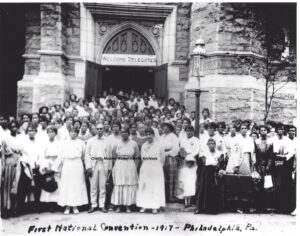
On August 31, 1917, Madam C. J. Walker hosted the first national convention of her Walker “beauty culturists” at Philadelphia’s Union Baptist Church, where a young contralto named Marian Anderson was just beginning to be noticed. More than 200 women from all over the United States gathered to learn about sales, marketing and management at what was one of the earliest professonal gatherings of American women entrepreneurs.
Walker–who founded her Madam C. J. Walker Manufacturing Company during the spring of 1906 in Denver after marrying her third husband, Charles Joseph “C.J.” Walker, earlier that year–had first begun selling hair care products in St.  Louis (more…)
Another 100 degree day! Crazy me has the air conditioning off, the windows open and the ceiling fan on high speed. I think it’s my way of communing with the folks I’m writing about because heaven knows it was HOT in A’Lelia Walker’s un-air conditioned 136th Street townhouse this time of year in 1915. And she did NOT like the heat!

Faith Ringgold's "The Sunflowers Quilting Bee at Arles" 1991
A few days ago while writing a chapter about A’LW’s friends, I came across a reference to someone named Ringgold. Couldn’t help but think of artist and quilter, Faith Ringgold, whose quilt “The Sunflowers Quilting Bee at Arles,” has long been one of my favorite pieces of artwork with my great-great-grandmother–and A’Lelia Walker’s mother– Madam C. J. Walker.
The abundance of sunflowers made me think of a letter Walker had written to her attorney, F. B. Ransom, in 1918 a few months after she had moved into her Irvington-on-Hudson, New York mansion, Villa Lewaro, and about how (more…)

Burial site of Madam C. J. Walker and A’Lelia Walker at Woodlawn Cemetery in The Bronx
June 30, 2011: Secretary of the Interior Ken Salazar today announced that The Woodlawn Cemetery in The Bronx–where entrepreneur Madam C. J. Walker and her Harlem Renaissance arts patron daughter, A’Lelia Walker, are buried–has been designated a National Historic Landmark, the highest recognition accorded to the nation’s most historically significant properties.
There are two other National Historic Landmarks associated with the legacy of the Walker women: The Madam Walker Theatre Center, a cultural arts organization in Indianapolis, and Villa Lewaro, the home Madam Walker built in Irvington-on-Hudson, New York in 1918. Villa Lewaro was added to the National Register of Historic Places in 1976. The Walker Theatre was added to the National Register in 1991.
Madam Walker died on May 25, 1919 at Villa Lewaro, where her funeral was held on May 30. Among the pallbearers were New York Age publisher Fred Moore, composer J. Rosamond Johnson, and Alpha Phi Alpha founder Vertner Tandy, Villa Lewaro’s architect.

Pallbearers for Madam Walker’s 1919 Funeral (Madam Walker Family Archives/www.aleliabundles.com)
A’Lelia Walker,who held a private ceremony for her mother at Woodlawn on June 3, 1919, was herself buried there in August 1931. (more…)

Roland Hayes 1924 Chicago Concert (Madam Walker Family Archives of A'Lelia Bundles/www.aleliabundles.com)
I learned to read music on a Chickering baby grand piano that had belonged to my great-grandmother, A’Lelia Walker, but it really was my mother, A’Lelia Mae Perry Bundles, and my grandmother, Mae Walker Perry, who had musical talent. As the only legally adopted daughter of A’Lelia Walker and granddaughter of entrepreneur Madam C. J. Walker, Mae had been afforded many privileges, including harp lessons and enrollment at Spelman College.
Several years ago, I discovered this program from lyric tenor Roland Hayes’s January 15, 1924 program at Chicago’s Orchestra Hall among Mae’s personal belongings. It now is part of my Madam Walker/A’Lelia Walker Family Archives. At the time of the concert, Mae recently had moved to Chicago. Like others in the city’s black community, she had looked forward to hearing Hayes sing selections–including Mozart’s “The Magic Flute,” black British composer (more…)

Recent Comments